
Czechgardenparty Czech Garden Party 2 Part 4 Full !full! Jun 2026
The Czech Garden Party, also known as the "Czech Garden Party" or "Česká zahradní párty" in Czech, has its roots in traditional Czech culture. The concept of a garden party, or "zahradní párty" in Czech, dates back to the 19th century, when it was a popular form of social gathering among the aristocracy. However, it wasn't until the 21st century that the modern Czech Garden Party began to take shape.
The search results for the keyword indicate that this specific query is primarily associated with adult entertainment content .
The music and dance of the Czech Garden Party are truly unforgettable. The event features a range of traditional Czech dances, including the polka, waltz, and mazurka. These dances are performed to lively electronic beats, with modern instruments like synthesizers and drum machines adding a contemporary twist.
The Czech Garden Party 2 Part 4 Full is more than just a party; it's an experience that will enrich your life in countless ways. Here are just a few reasons why you shouldn't miss out: czechgardenparty czech garden party 2 part 4 full
If you are looking for specific video content using this string, consider refining your search terms based on your target category: Target Content Recommended Search Terms Expected Source "Prague Garden Party food festival video recap" YouTube, Official Tourism Portals Theatrical Performances "Václav Havel Zahradní slavnost full play" Czech Television Archives ( Česká televize ) Travel Vlogs "Prague Castle Royal Garden festival vlog" Independent Travel Creators
Charcoal-grilled pork shoulder ( krkovice ), smoked bratwurst, and marinated poultry. Potato Salad Pickled Vegetables
But the centerpiece? The Řízková Revolution. The Czech Garden Party, also known as the
Pinpoints the exact segment or chapter of a multi-part release schedule.
Encourage guests to bring guitars for a late-night sing-along around the fire. Preparation Checklist
Splitting videos allowed viewers with slower internet connections to buffer and watch segments sequentially without experiencing massive loading failures. The search results for the keyword indicate that
Join the conversation on social media using the hashtag #CzechGardenParty2Part4Full, and stay up-to-date with the latest news and updates from the event. We look forward to seeing you at the Czech Garden Party 2 Part 4 Full!
The Czech Garden Party 2 Part 4 Full promises to deliver an unforgettable experience, with a diverse lineup of activities, entertainment, and attractions that cater to all ages and interests. From traditional Czech music and dance to modern art exhibitions, and from delicious food and drink to interactive games and workshops, there's something for everyone at this spectacular event.
eFatigue gives you everything you need to perform state-of-the-art fatigue analysis over the web. Click here to learn more about eFatigue.
Czechgardenparty Czech Garden Party 2 Part 4 Full !full! Jun 2026
Welds may be analyzed with any fatigue method, stress-life, strain-life or crack growth. Use of these methods is difficult because of the inherent uncertainties in a welded joint. For example, what is the local stress concentration factor for a weld where the local weld toe radius is not known? Similarly, what are the material properties of the heat affected zone where the crack will eventually nucleate. One way to overcome these limitations is to test welded joints rather than traditional material specimens and use this information for the safe design of a welded structure.
One of the most comprehensive sources for designing welded structures is the Brittish Standard Fatigue Design and Assessment of Steel Structures BS7608 : 1993. It provides standard SN curves for welds.
Weld Classifications
For purposes of evaluating fatigue, weld joints are divided into several classes. The classification of a weld joint depends on:
- the macroscopic geometry of the pieces welded,
- the direction of the cyclic stresses, and
- the location of the crack that leads to failure.
Two fillet welds are shown below. One is loaded parallel to the weld toe ( Class D ) and the other loaded perpendicular to the weld toe ( Class F2 ).
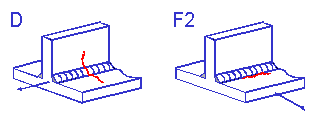
It is then assumed that any complex weld geometry can be described by one of the standard classifications.
Material Properties
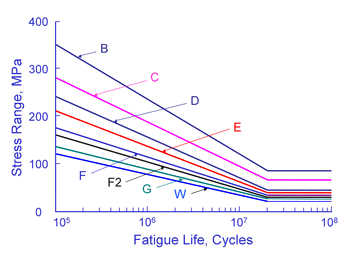
The curves shown above are valid for structural steel welds. Fatigue lives are not dependant on either the material or the applied mean stress. Welds are known to contain small cracks from the welding process. As a result, the majority of the fatigue life is spent in growing these small cracks. Fatigue lives are not dependant on material because all structural steels have about the same crack growth rate. The crack growth rate in aluminum is about ten times faster than steel and aluminum welds have much lower fatigue resistance. Welding produces residual stresses at or near the yield strength of the material. The as welded condition results in the worst possible residual or mean stress and an external mean stress will not increase the weld toe stresses because of plastic deformation. Fatigue lives are computed from a simple power function.

The constant C is the intercept at 1 cycle and is tabulated in the standard. This constant is much larger than the ultimate strength of the material.
The standard is only valid for fatigue lives in excess of 105 cycles and limits the stress to 80% of the yield strength. Experience has shown that the SN curves provide reasonable estimates for higher stress levels and shorter lives. In eFatigue, the maximum stress range permitted is limited by the ultimate strength of the material for all weld classes.
Design Criteria
Test data for welded members has considerable scatter as shown below for butt and fillet welds.
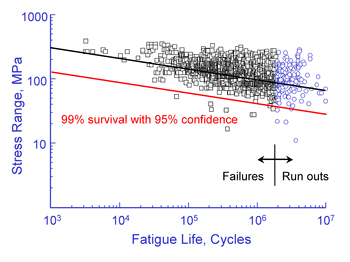
Some of this scatter is reduced with the classification system that accounts for differences between the various joint details. The standard give the standard deviation of the various weld classification SN curves.
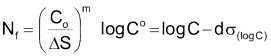
The design criteria d is used to determine the probability of failure and is the number of standard deviations away from the mean. For example d = 2 corresponds to a 2.3% probability of failure and d = 3 corresponds to a probability of failure of 0.14%.
Cascade Zone. All rights reserved. © 2026